


Balance Board
Balance Board
🌟Collapses into your backpack
🌟Nothing left outside to steal
🌟Train, walk, ride, repeat


Couldn't load pickup availability

Balance Board
100% Money-Back Guarantee
100% Money-Back Guarantee
Shop with total confidence. We offer a 30-day money-back guarantee — not happy with your order? Send it back within 30 days for a full refund, no questions asked. Straightforward, simple, and completely risk-free.
How Do I Reach Customer Support?
How Do I Reach Customer Support?
We're here whenever you need us. Get in touch at support@cartlywise.com or through the contact form on our website — our team is standing by and will respond promptly to help you out.
About us
About us
At cartlywise, customers come first — always. We offer high-quality products paired with fast, reliable worldwide shipping. With warehouses strategically placed around the globe, we make sure every order reaches you smoothly, safely, and without the wait.



Balance isn't a talent. It's a skill, and it responds to practice.
Most balance boards give you one level of difficulty — too easy after a fortnight, or too hard to ever start. This one has seven, set by four magnetic stoppers you move with your fingers. You begin somewhere you can actually stand, and you move the goalposts as your ankles catch up.
-
Seven modes, one board
Rocker, roller and ball, with the tilt range you choose. It's a beginner's board and an advanced one depending on where the stoppers sit.
-
Stoppers that snap on and off
Four magnetic blocks, no tools and no screws. Change the difficulty between sets, or between two people using it in the same session.
-
Birch deck, rated to 450 lb
Solid birch rather than thin plywood — 204 kg capacity and no flex underfoot, which is what makes the board feel trustworthy enough to push on.
A deck, a roller, a ball, and four small magnets.
The board alone gives you a rocker. Add the roller and it slides side to side like a surfboard. Swap in the ball and it moves in every direction at once. The stoppers decide how far any of that is allowed to go.
Birch deck, 30" × 11.8"
Long enough for a proper stance rather than a tightrope. Solid birch doesn't flex under load the way budget plywood does.
Textured non-slip top
A matte EVA surface, not grip tape. It holds bare feet without sanding your skin off, and works just as well in trainers.

Floor-friendly roller
Smooth-cased and sealed, so it won't scratch hardwood or collect hair and grit off a carpet the way open-hub rollers do.
2.8" solid rubber ball
Solid all the way through — nothing to inflate, nothing to leak, and no slow deflation halfway through a month of training.
How people are using it


Bought for one reason. Used for four.
People buy a balance board for a specific thing — a season coming up, an ankle that isn't right, a desk they stand at. Then it stays out on the floor and everyone in the house has a go.

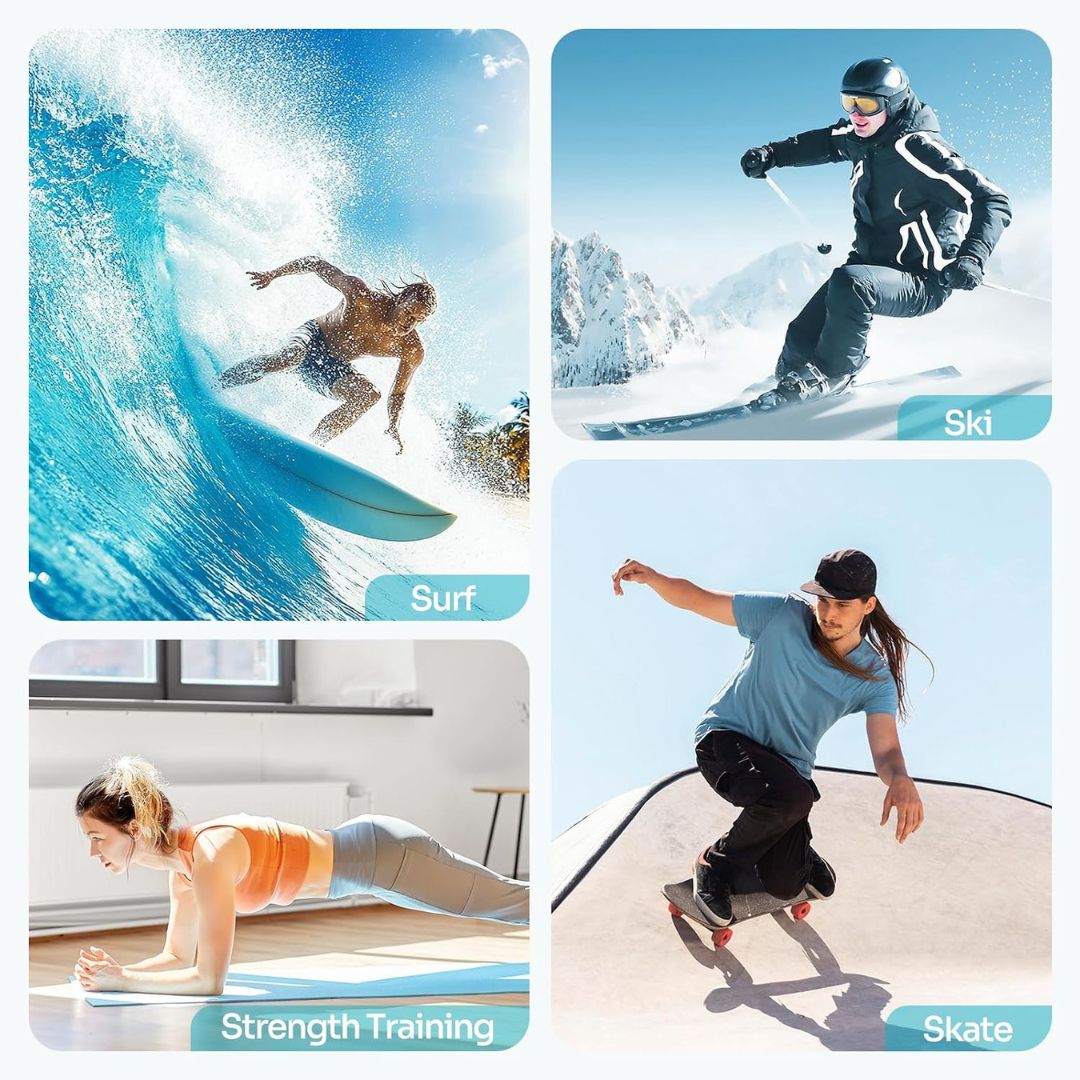
Board sports, out of season
The roller mimics the side-to-side weight shift of surfing, snowboarding and skating. It keeps the movement pattern alive between trips.
Ankles and knees
Small, controlled instability is standard in rehab work. The stoppers let you keep the range tiny at first and open it up slowly.
Standing desks
With all four stoppers on, the movement is subtle enough to work through. It gives your legs something to do during long calls.
Strength work
Push-ups, planks and squats on an unstable surface recruit stabilisers that a solid floor lets you skip entirely.
Your questions, answered straight
I've never used one. Where do I start?
With all four stoppers fitted and the roller in the middle. That's the narrowest tilt range the board offers, and it's genuinely manageable on day one. Stand next to a wall or a worktop for the first few sessions so you have something to touch — not to lean on, just to reach for.
Which mode is which?
The printed instructions are thin on this, so here's the honest progression: four stoppers is easiest, then two, then none. Once you're steady with the roller and no stoppers, switch to the ball — it moves in every direction rather than two, and it's a real step up. Most people spend a few weeks per stage.
Will it damage my floor?
The roller is fully cased and smooth-running, so it doesn't scratch hardwood or pick up hair and grit the way open-hub rollers do. On hard floors it's fine as-is; on tile, a thin mat underneath cuts the noise and gives the roller more bite.
Can I use it barefoot?
Yes — the top is a textured matte surface rather than grip tape, so it holds bare feet without the sandpaper feel that makes some boards unpleasant after twenty minutes. It grips trainers just as well if you'd rather wear shoes.
How big is it, and what weight does it take?
The deck is 30" × 11.8" — long enough for a shoulder-width stance rather than a tightrope — and it's rated to 450 lb (204 kg). The ball is 2.8" of solid rubber, so there's nothing to inflate and nothing to go soft over time.
What if it isn't right for me?
Then you get your money back. Every order is covered by our 30-day returns policy — get in touch and we'll sort it out. No hoops, no chasing.
30-day returns
Give it a month of five-minute goes
If it doesn't earn its spot on your floor, send it back within 30 days and we'll refund you. Here's roughly how the first month goes.
Five minutes is plenty
All four stoppers on, roller centred, a wall within reach. You'll wobble hard for the first minute and then something clicks. Stop while it's still going well — the muscles doing this work tire faster than you'd expect.
You stop looking down
Balance stops being a conscious effort and moves into your ankles. That's the point to pull two stoppers off and make it hard again — the board only keeps working if it stays slightly beyond you.
It stays out on the floor
No stoppers, and the ball starts to look tempting. By now you're using it during phone calls and while the kettle boils, which is more total practice than any session you'd have scheduled.
Over +10.000 orders
Why our customers love us
-

Being able to seamlessly switch between the tube and the sphere keeps the workouts feeling fresh and engaging. It genuinely feels like having two completely different balance trainers, and the birch wood easily handles my 220-pound frame.
-

You really don't need a massive home gym when a single wooden board can annihilate your core in fifteen minutes. The grip tape is super aggressive, locking my shoes in place so I can focus entirely on my stabilizer muscles.
-

Compared to the basic rocker boards that only tilt side-to-side, the free-moving accessories here provide true dynamic training. The seven challenge modes let me progress from a complete beginner to feeling almost ready to paddleboard again.


